Over the past few months I have begun the serious restoration of my collection of cassette decks. I would frequent thrift stores buying decent models, use them until what I thought were the irreplaceable parts wore out, then return them back to the thrift store. I kept a few along the way that were higher-end in the hopes I could someday revive them.
Through a serendipitous google part search one day I discovered that I could buy unbranded replacement parts on Alibaba provided I had the dimensions of the piece; my folly had been endless and fruitless searches for brand and model-specific parts, OEM stuff that hadn’t been made for decades.
One by one I have since disassembled, removed and measured, ordered and patiently waited for an assortment of replacement belts, pinch rollers, gears and even an idler tire to arrive.
Though cassettes are experiencing a small renaissance as of late I had never completely abandoned them. I have a large collection of cassettes alongside all the vinyl and CDs, and the world of underground extreme metal continued to release music on cassettes long past their commercial viability and does so to this day. The equipment became the biggest issue; not a lot of decent decks got made after the mid-nineties.
Tapes were always the audio underdogs. Portability and recordability were noble features but often the sound quality was lacking. You had to spend a lot of money for a deck that sounded good, and if you didn’t know how to maintain it that wouldn’t last anyway. Most decks were cheap rudimentary additions that made horrid recordings to make stereos seem more versatile with the main event usually being the turntable, which was eventually replaced by the CD player. Tape use was cumbersome unless you were in the habit of listening to albums beginning to end. It was the consolation prize, better than not having the album but not as flashy as the vinyl or CD.
When I started buying music tapes and vinyls were a half to a third of the price of a CD. A lifelong obsession began with teenage fiscal practicality. I preferred having more music over having the fancy format. CDs basically happened when I got birthday and christmas money. From that practicality grew my love of analog sound and all of its glorious imperfections. I don’t hate CDs, I have hundreds of them, but I still intentionally buy the analog version whenever available and priced within reason (looking at you, Tool). Thanks to the recent small tape resurgence analog can sometimes be had for under $20 once again (thank you to the hipster turntable-less vinyl download code collectors for driving LP prices sky-high. That’s a whole other rant).
Fixing audio equipment has been somewhat of a saviour in my recovery from PTSD. It’s my version of meditating. I enjoy it immensely. Until covid it was also getting me out of the house as I would drive around to thrift stores shopping for prospective pieces. I love taking something apart, trying to figure out how it works and if broken trying to fix it. I love listening to music and I take pride in collecting, restoring and maintaining the equipment I do that with. 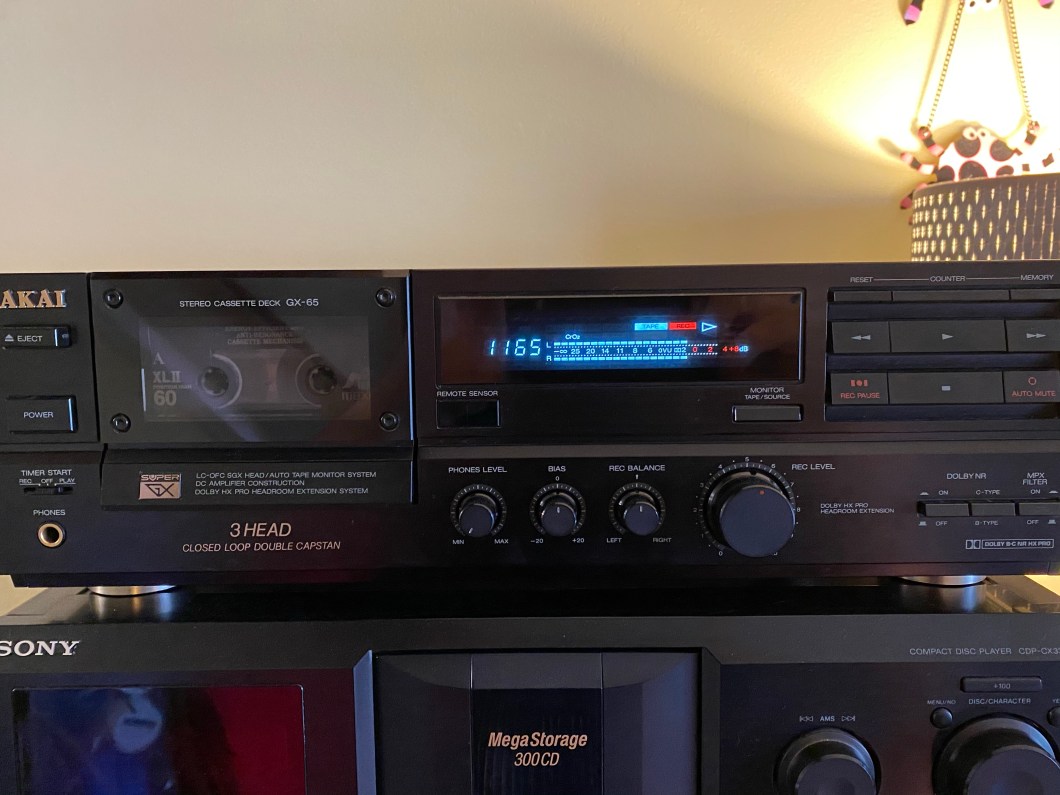
The Akai GX-65. One of my 2 ‘crown jewels’. A basic high-end 3 head deck that I found on the floor of a value village and purchased for $10. When plugged in it would turn on, motors would respond but the mechanism was stuck half-engaged and thus the door wouldn’t open. Cosmetically it was in great shape. Challenge accepted. I hung on to this for years before finally getting around to restoring it. It needed new belts, new pinch rollers, a good dusting, some squirts of fader lube in the buttons and pots and an immense amount of time aligning the pinch rollers and head azimuth as well as tweaking all the variable resistor settings on the circuit board so that the sound going in was the sound coming out both visually on the VU meter as well as audibly and that its recordings were also identical sounding on other decks. Years ago this calibration would have been done using frequency test tapes to measure output voltages and mirrored guide tapes for the alignment but since those don’t readily or affordably exist anymore I did it all by eye and ear. Because the output on this deck has both a high and low frequency adjustment I was even able to adjust it to sound slightly ‘brighter’ than the average tape deck. I can sense the purists shaking their heads but I’m doing this for me and I’m pleased so fuck how it “should” sound. 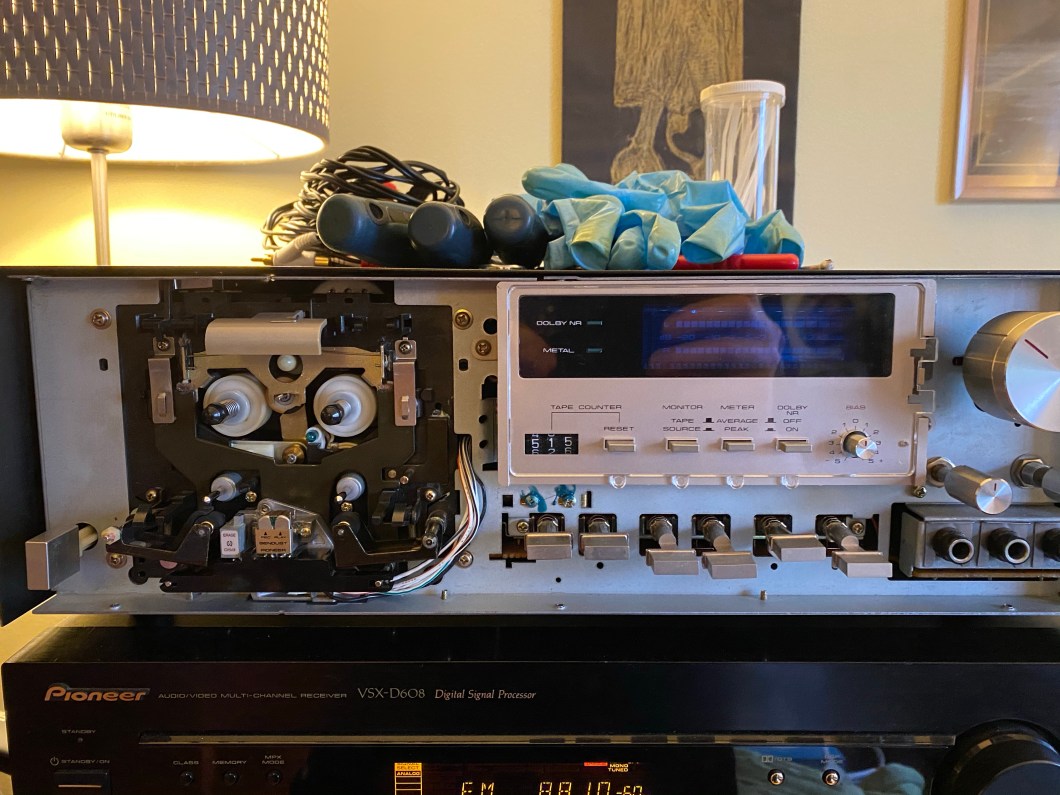
This is a pioneer CT-F850. Also a rudimentary high-end 3 head deck. This too was a $10 Value Village find. I have had this one for a while as well owing to it’s status of being from the coveted ‘blue line’ series (nicknamed for the colour of the flourescent VU meter). Obviously since it’s missing the front cover it’s still being worked on, but it too needed new belts (4 out of 6; the complicated to replace capstan belts seem fine so I’m leaving them be for now), 2 new pinch rollers which were both at least the same size (unlike the Akai), a new idler tire, a mechanical fix for a solenoid not engaging during playback/record, a serious cleaning and a few drops of fader lube in all the pots and buttons. The roller alignment was much easier on this deck since you can pop a clear tape in and actually visualize the leader tape in the guide without needing a mirror tape. Now it’s ready to be adjusted and tweaked. A cursory adjustment to playback levels while adjusting the head azimuth is as far as I have got but I’m stoked to get this brick shithouse of a deck up and running fully.
This is what I like to do when I “isolate”. This evolved into sitting and drinking in silence, but it’s gradually coming back to me. It’s still isolating in the literal sense of the therapy definition but it’s far more like my old self than being a social butterfly ever was. Now that I don’t go to work anymore I don’t go out much anymore or deal with people much anymore. I’m still supposed to want and need the human interaction that work gave me instead of staying home and reviving a 40 year old obsolete machine. Problem is I’m just not sure I do.

